
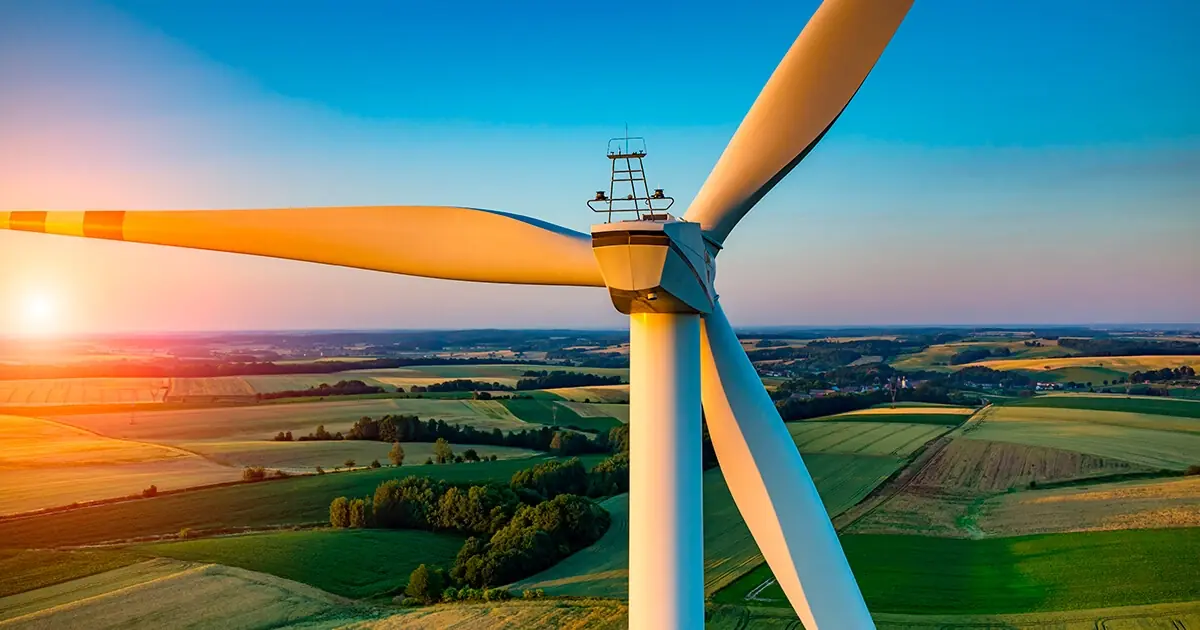
Services · Renewable energy
Wind farms — internal MV network and grid connection
Wind turbines often stand kilometres apart and far from the point of connection. They are linked by an underground medium-voltage cable network running across fields, roads and ditches. We build that infrastructure — from the lines between turbines to the connection with the MV switchgear of the grid substation.
Our role
Kilometres of MV cable in open country — our speciality
Each wind turbine has its own transformer that steps the generator voltage up to medium voltage. Turbines are connected with MV cables into strings, and the strings run to MV switchgear at a collection point — on smaller farms a junction or switching station connected to the operator's MV network, on larger ones a customer substation (in Polish: GPO) where the power is transformed up to high voltage.
For a contractor this means long cable routes across farmland, numerous crossings with local roads, drainage ditches and other utilities, dozens of joints and terminations and rigorous acceptance testing. These are exactly the works we carry out on MV lines for operators — with our own GRUNDODRILL 15 XPT drilling rig, CAT excavators and a Tesmec ARS405 puller for cable pulling.
In fairness: our reference letters do not yet include a completed wind farm. What we show instead are contracts with long MV cable lines — including 3 × 5,715 m of cable for ENEA Operator and a 5,725 m 15 kV line with around 600 m of drilled crossings in Toruń — because they best reflect the scale of work on a wind farm network.
- MV cable network linking turbines into strings
- Lines to the MV switchgear of the HV/MV substation or to the operator's network
- Drilled crossings under roads, ditches and watercourses
- Joints, terminations, acceptance testing and as-built survey
The developer's path
A wind farm's route to grid connection — in brief
Connecting a wind farm is a multi-year process, and its details depend on the operator, capacity and voltage level. In outline:
- 01
Connection conditions
The developer applies to the distribution system operator (or, for large capacities, the transmission operator) for connection conditions; the operator assesses the network's capacity and issues the conditions or refuses.
- 02
Connection agreement
The agreement sets out the point of connection, the works on the developer's and operator's side and the programme.
- 03
Design and permits
Designing the farm, its internal network and the grid substation, agreements with the operator, and the decisions and permits the scheme requires.
- 04
Construction
Turbine foundations and erection, access roads, the grid substation and the MV cable network — the last of these is where we work.
- 05
Testing and acceptance
Cable tests and measurements, as-built documentation, survey and acceptance by the operator.
- 06
Energisation
Turbine commissioning, the tests required by the operator and the remaining formalities — including with the Energy Regulatory Office (URE) — after which the farm starts generating.
Connection elements
A wind farm's electrical infrastructure
Typical MV elements of a wind farm and what we do on them:
| Element | Function | BIGBUD's scope |
|---|---|---|
| Turbine transformer and MV switchgear in the tower | Steps the generator voltage up to MV; usually supplied with the turbine | Bringing in and connecting the MV cables, terminations, testing |
| Internal MV cable network | Links turbines into strings and takes them to the collection point | Trenching, drilling, MV cable laying, joints, route marking |
| MV junctions and switchgear | Splitting and connecting strings, ownership boundaries | Setting junctions, fitting out, connections |
| Customer HV/MV substation (GPO) with MV switchgear | Collects power from the strings and transforms it to HV on larger farms | MV cable lines to the substation's MV switchgear; HV works are done by specialist contractors |
| Line to the operator's substation / DSO network | Links the farm to the operator's network at the point of connection | In the MV option — building the cable line and the tie-in agreed with the DSO |
| Ducts and SCADA fibre | Communication between turbines, substation and the control system | Ducts and cable ducting in the shared trench with the MV cables |
How the works run
How we build a wind farm cable network
Design and route review
We review the network design, connection conditions and the route on the ground: soils, crossings, land access and the order in which turbine bases are released.
Scope of works
- Document review
- Site visit
- Drilling plan
Result
- Quotation and programme
Procuring cables and accessories
We plan drum lengths to keep the number of joints down and order accessories to match the cables.
Scope of works
- Cable length planning
- Purchase orders
Result
- Drum delivery plan
Trenching and drilling
We trench across farmland and drill under roads, ditches and watercourses, coordinated with the road and foundation works.
Scope of works
- Machine trenching
- HDD crossings
- Protective ducts
Result
- Route ready for cable
Cable laying and jointing
We pull cable off the drums with a puller, make straight joints and terminations, and connect turbines and junctions.
Scope of works
- Laying MV cables
- Joints and terminations
- Connections
Result
- Cable strings ready for testing
Backfill and reinstatement
We backfill with route marking and restore farmland to the condition agreed with the landowners.
Scope of works
- Backfill and compaction
- Land restoration
Result
- Land back in use
Testing, records, acceptance
We carry out cable acceptance tests, the as-built survey and the documentation needed for acceptance and commissioning of the farm.
Scope of works
- Voltage tests and measurements
- As-built survey
- Documentation
Result
- MV network ready for energisation
MV competence
Long MV cable lines in our reference letters
These are jobs on operators' networks, not wind farms. We show them as proof of competence: long MV cable routes, hundreds of metres of drilled crossings, joints, terminations and ZKSN junctions — all confirmed in writing by the clients.
ENEA Operator — MV 20 kV network, Niegosławice
Lubuskie Voivodeship
Toruń — MV 15 kV line undergrounding
Kuyavian-Pomeranian Voivodeship
MV/LV network rebuild — 8 villages
Greater Poland / Lubuskie Voivodeships
Photos
From our sites
FAQ
Wind farms — frequently asked questions
Do you build 110 kV customer substations?
Our speciality is medium- and low-voltage networks. On a farm with its own HV/MV substation we build the MV cable lines and connections to the substation's MV switchgear; the high-voltage part is delivered by specialist contractors.
Have you completed wind farms before?
Our reference letters do not yet include a completed wind farm. They cover long MV cable lines, drilling, junctions and MV/LV substations on operators' networks — the works a farm's internal network is made of. Full letters: References.
What cables are used in a wind farm network?
Usually single-core MV cables with aluminium conductors and cross-linked polyethylene insulation, sized for the string's capacity and route length. The type and size are always set by the design. More in MV cables: XRUHAKXS and NA2XS(F)2Y.
How do you cross roads and ditches on the cable route?
By directional drilling with our own GRUNDODRILL 15 XPT rig, pulling in a protective duct. Across our contracts we have completed around 1.5 km of drilled crossings and pipe jacking. See horizontal directional drilling.
Can you work in parallel with turbine erection?
Yes — that is the usual situation. We agree the cable-laying programme with the general contractor so it does not clash with turbine component deliveries and crane work.
Do you work anywhere in Poland?
Yes. Our office is in Kraków and we move our plant with our own transport — including to sites in northern and western Poland, where most wind farms are being built.
See also
Related services
Solar farms
Solar farm electrical infrastructure: internal MV cable network, transformer substations, MV switchgear and the line to the DSO grid. Grid connection works.
Learn moreMV and LV cable lines
Construction, rebuilding and repair of MV 6–30 kV and LV 0.4 kV cable lines: trenching, drilling, cable laying, joints, terminations, testing and handover.
Learn moreHorizontal directional drilling
Horizontal directional drilling and pipe jacking under roads, railways and rivers — ducts for MV, LV and fibre cables. Own Tracto-Technik GRUNDODRILL rig.
Learn morePlanning a wind farm cable network?
Send us the MV network design and the connection conditions — we will quote with a works programme.