
Services · Technologies and works
Fibre-optic ducts — trenching, drilling, ducts and chambers
We build the duct networks that fibre-optic cables run through: from setting out the route, through trenching and directional drilling, to laying HDPE ducts and microducts, installing chambers and the as-built survey. With the same plant and the same site organisation we use on MV cable lines.
What the service involves
Linear works are our daily bread — telecoms included
A fibre duct network is an underground system of ducts and chambers into which optical cables are later installed, usually by blowing. The quality of this backbone decides whether the cable can be blown over the design length, whether the network can be extended later and whether the operator will have to dig up the road verge again in a few years' time.
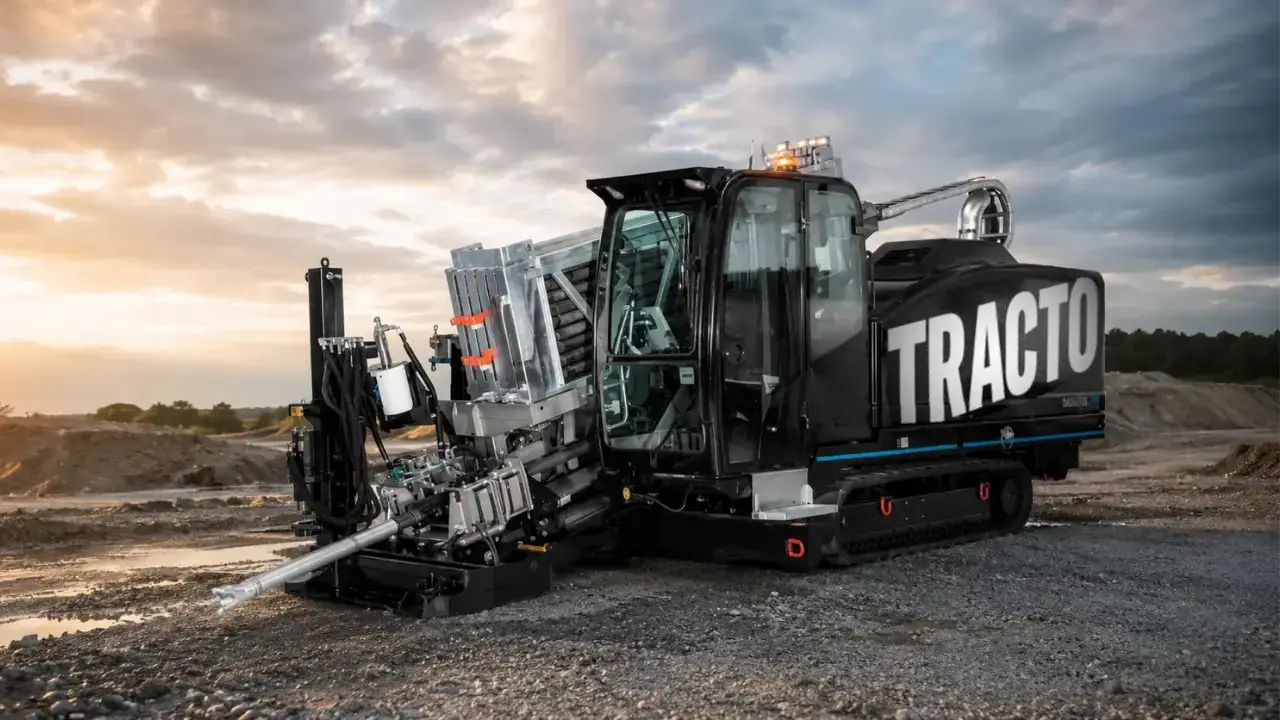
From a civil-works point of view, fibre ducting is very close to what we do on medium-voltage cable lines: a route in the road verge or across private land, crossings with roads, ditches and other utilities, directional drilling, reinstatement and an as-built survey. That is why we carry it out with our own crews and our own plant — a CAT 302.7 mini excavator, a CAT 432 backhoe loader, a GRUNDODRILL 15 XPT directional drill and a Volvo truck with a loader crane.
We often lay fibre ducts alongside the construction or rebuild of a power network: a shared trench and a single site organisation cut costs and shorten the time the road is occupied. We can also deliver ducting as a stand-alone job for a telecoms operator or a general contractor.
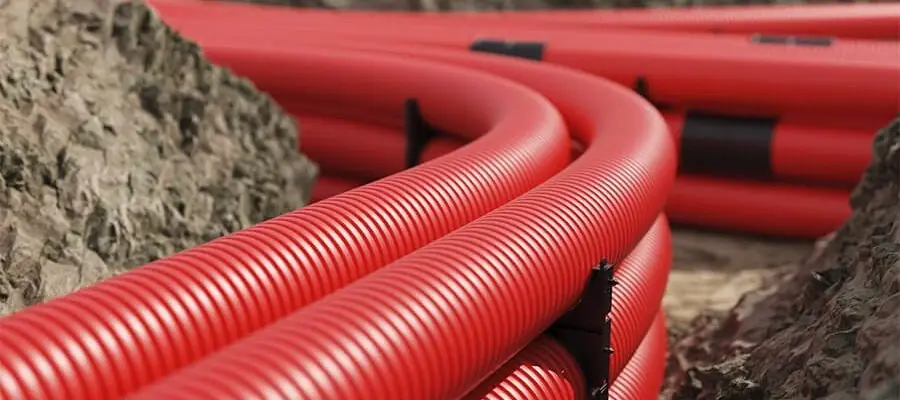
- HDPE ducts (e.g. 40 mm) and microduct bundles
- Cable chambers and joint boxes, sleeve ducts at crossings
- Horizontal directional drilling under roads, railways and watercourses
- Proving and pressure tests, as-built survey
Scope
What we deliver on a fibre duct project
Setting out and route survey
Survey set-out, locating existing utilities and, where needed, trial holes before heavy plant moves in.
Open-cut trenching
Machine and hand digging near live services, bedding, laying ducts at design depth, backfilling and compaction.
Directional drilling
Crossing roads, driveways, railways, ditches and watercourses without open cut — with our own rig. Details on the directional drilling page.
Ducts and microducts
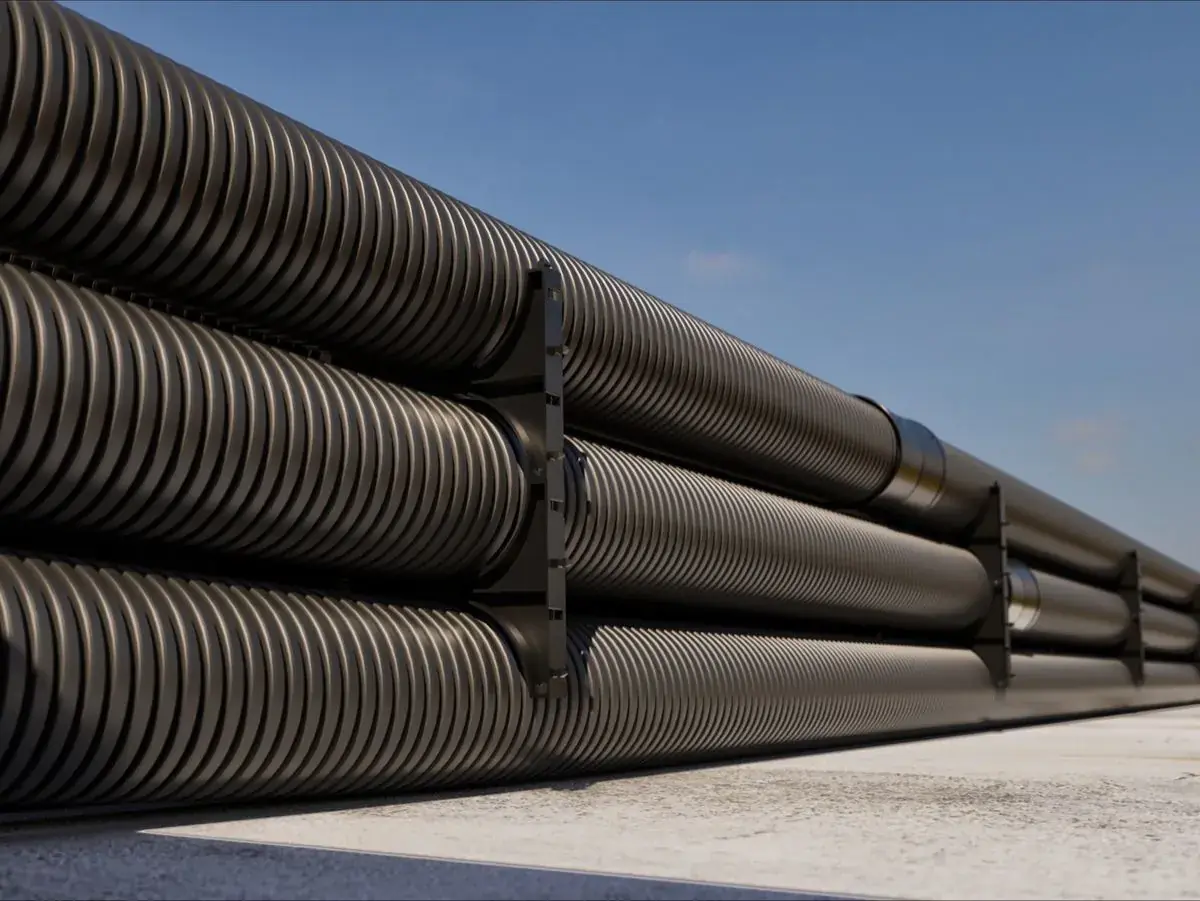
Laying HDPE ducts, sleeve ducts and microduct bundles, jointing with couplers, sealing and marking the route with warning tape.
Cable chambers
Installing chambers and joint boxes where the design calls for them — at changes of direction, branches and blowing points.
Testing and records
Duct proving and pressure tests, reinstatement, as-built survey and the documentation needed for handover.
How the works run
Building a duct network, step by step
The sequence is broadly the same on any linear job. Below is a typical run of works — the details always follow the design and the conditions set by landowners and road authorities.
Design review and pricing
We review the design, bill of quantities and maps, and check ground conditions, access and crossing points on site. On that basis we propose the method (open cut or drilling) and a programme.
Scope of works
- Checking the route and clashes
- Choosing drilling locations
- Quotation with programme
Result
- Price and works plan
Pre-start formalities
We prepare the temporary traffic management, notify road authorities and landowners of the start of works, agree reinstatement requirements and access to private plots.
Scope of works
- Traffic management design and set-up
- Liaison with authorities
- Ordering materials
Result
- Ready to mobilise
Setting out the route
The surveyor sets out the route and chamber positions. Existing services are located from maps and — where the maps are doubtful — by trial holes.
Scope of works
- Survey set-out
- Utility location
Result
- Route marked on site
Trenching, drilling and duct laying
We trench in sections and lay the ducts straight away, so trenches are not left open. Obstacles that cannot be dug through are crossed by directional drilling, pulling the sleeve or the duct itself in behind the reamer.
Scope of works
- Machine and hand digging
- HDD crossings
- Laying ducts and installing chambers
Result
- Duct network in the ground
Backfill and reinstatement
We backfill and compact in layers, lay warning tape and reinstate surfaces and land to the standard agreed with the owner or authority.
Scope of works
- Compaction
- Surface and verge reinstatement
Result
- Land restored
Testing, survey and handover
We prove and pressure-test the ducts, carry out the as-built survey and compile the documentation the client needs for acceptance.
Scope of works
- Proving and pressure tests
- As-built survey
- Handover documentation
Result
- Ducts ready for cable blowing
Method
Open cut or directional drilling?
We use both every day and often combine them on one route. A general comparison:
| Criterion | Open cut | Directional drilling (HDD) |
|---|---|---|
| Typical use | Verges, farmland and green areas, unobstructed sections | Roads, driveways, railways, ditches and watercourses, wooded areas |
| Ground disturbance | Whole route excavated, reinstatement required | Launch and reception pits only |
| Traffic disruption | Usually greater, depends on section length | Minimal — the road stays open |
| Clash control | Direct — services are visible in the trench | Needs a thorough route survey before drilling |
Linear works experience
Same works, different medium
Our reference letters do not yet include a purely telecoms project — and we won't pretend otherwise. What they do show is kilometres of MV cable lines and around 1.5 km of directional drilling and pipe jacking: exactly the civil works a fibre duct network is made of.
Toruń — MV 15 kV line undergrounding
Kuyavian-Pomeranian Voivodeship
MV/LV network rebuild — 8 villages
Greater Poland / Lubuskie Voivodeships
Konin — RS Maliniec 15 kV switching station
Greater Poland Voivodeship
Photos
From our sites
FAQ
Fibre-optic ducts — frequently asked questions
Do you blow and splice the fibre as well?
Our speciality is the civil works: trenching, drilling, ducts, chambers and reinstatement. Cable blowing, splicing and optical testing are usually done by a specialist telecoms contractor — we agree the split of scope case by case.
Can you lay fibre ducts in a shared trench with an MV or LV cable?
Yes, if the design provides for it and both network owners agree. A shared trench must respect the separations and laying arrangement set out in the design and in the operators' requirements.
How long can your drilled crossings be?
The length of a single bore depends on the ground, the duct diameter and site conditions. Send us the profile and a description of the obstacles and we will confirm the method. More in How directional drilling works.
Who deals with the road authority?
Permits to place ducts in the road corridor are normally obtained by the client at the design stage. We prepare traffic management for the works, notify the start on site and reinstate surfaces to the authority's conditions.
Do you work as a subcontractor to telecoms operators?
Yes. We can take on all the civil works on a section or just part of them, e.g. only the road crossings. See also the page for general contractors.
Where do you work?
Across Poland. Our office is in Kraków and we move our plant with our own crane truck.
See also
Related services
Horizontal directional drilling
Horizontal directional drilling and pipe jacking under roads, railways and rivers — ducts for MV, LV and fibre cables. Own Tracto-Technik GRUNDODRILL rig.
Learn moreMV and LV cable lines
Construction, rebuilding and repair of MV 6–30 kV and LV 0.4 kV cable lines: trenching, drilling, cable laying, joints, terminations, testing and handover.
Learn moreUtility conflict relocation
Relocating MV and LV networks that clash with roads, railways and new developments: cable diversions, undergrounding, HDD, DSO outages and acceptance.
Learn morePlanning a fibre duct network?
Send us the design or a route map with quantities — we will reply with a quotation, a proposed method and a programme.