
Knowledge · Glossary
Power-network glossary
Key abbreviations and terms from medium- and low-voltage network construction in Poland, explained briefly — with the Polish term in brackets where it helps. Definitions are indicative; on a specific project the design, the operator's requirements and current regulations prevail.
A
Acceptance testing
The set of tests carried out after a line or substation is completed, including insulation resistance measurement, continuity checks of conductors and screens, voltage tests and earthing measurements. The test reports form part of the acceptance documentation.
As-built documentation
The set of documents handed over to the investor after construction: the design marked up with changes, test reports, the as-built survey, material data sheets and declarations.
As-built survey (inwentaryzacja powykonawcza)
A survey of the completed network carried out by a surveyor before backfilling or immediately after the cable is laid. The result is lodged with the national geodetic records and is a condition of acceptance.
B
Base map for design purposes
Mapa do celów projektowych: an up-to-date topographic map showing existing utilities, prepared by a licensed surveyor for the purposes of a building design.
Bentonite drilling fluid
A mixture of water and bentonite clay, sometimes with additives, used in directional drilling. It stabilises the borehole, carries cuttings out, and cools and lubricates the tools.
C
Cable duct system (kanalizacja kablowa)
A system of ducts or duct blocks laid in the ground through which cables are run. It allows a cable to be replaced or added without re-excavating.
Cable joint (mufa)
Accessory used to connect two lengths of cable (straight joint) or cables of different types (transition joint). It restores the insulation, screen and sheath at the connection point.
Cable screen
The metallic layer (usually copper wires and tape) surrounding the insulation of an MV cable. It controls the electric field, carries capacitive and fault currents and provides touch safety.
Cable termination (głowica)
Accessory that ends an MV cable and allows it to be connected to equipment or an overhead line. There are indoor, outdoor and connector (plug-in) terminations.
Cable termination pole
An overhead line pole where the line changes to cable. It carries outdoor cable terminations, surge arresters and often a disconnector or switch-disconnector.
Cable winch / puller
A machine for pulling cables mechanically through ducts or trenches while controlling the pulling force, so that the cable's permissible tension is not exceeded.
Conductor cross-section
The cross-sectional area of the conductor in mm². In the notation 1×150/25 mm², the first number is the main conductor cross-section and the second is the screen cross-section.
Connection agreement (umowa o przyłączenie)
An agreement between the DSO and the party being connected, concluded on the basis of the connection conditions. It sets out the scope of work on each side, deadlines and the connection fee.
Connection capacity (moc przyłączeniowa)
The active power planned to be drawn from or fed into the network, as stated in the connection conditions and agreement. It largely determines how much network reinforcement is needed.
Connection conditions (warunki przyłączenia)
A document issued by the DSO at the request of the party seeking connection. It specifies where and how the installation will be connected, the technical parameters and the requirements for the installation.
Covered-conductor overhead line
An MV line with conductors coated in an insulating layer that limits the effects of brief contact with branches. It allows a narrower clearance corridor than a bare-conductor line.
D
DSO — distribution system operator (OSD)
The company responsible for operating, developing and connecting users to the distribution network in a given area. The DSO issues connection conditions and accepts new network sections.
E
Earthing
Connection of installation parts to earth via earth electrodes. It provides protection against electric shock and ensures protective devices operate correctly; its resistance is verified by measurement.
F
Fibre-optic ducts
Ducts and microducts laid in the ground into which fibre-optic cables are blown or pulled. They are often built alongside power networks.
G
GPO — main collection point
Główny Punkt Odbioru: the collector substation of a solar or wind farm, where the farm's internal lines meet and from which energy is fed into the operator's network. It usually houses switchgear, protection and metering.
GPZ — HV/MV primary substation
Główny Punkt Zasilający: a substation that transforms 110 kV down to medium voltage. MV lines supplying towns and rural areas leave from the GPZ.
H
Horizontal directional drilling (HDD)
A trenchless method of installing ducts under obstacles: a steerable pilot bore is drilled, then enlarged, and protective ducts are pulled back through it. Used under roads, railways, watercourses and in wooded areas.
HV — high voltage (WN)
In Polish distribution practice, 110 kV. HV lines connect GPZ substations and are the highest voltage level operated by distribution system operators.
I
Insulation resistance
The electrical resistance of insulation, measured with an insulation tester. A very low value indicates moisture ingress or damage to the cable or accessories.
Insulators
Porcelain, glass or composite components that attach overhead line conductors to the pole structure and insulate them electrically from it.
Inverter
A device that converts direct current from PV modules into alternating current matching the grid. In solar farms it also performs functions required by the operator, such as reactive power control.
L
Lorry-mounted crane (HDS)
A hydraulic loader crane mounted on a truck. Used to load and unload cable drums, prefabricated elements and substation components.
LV switchboard
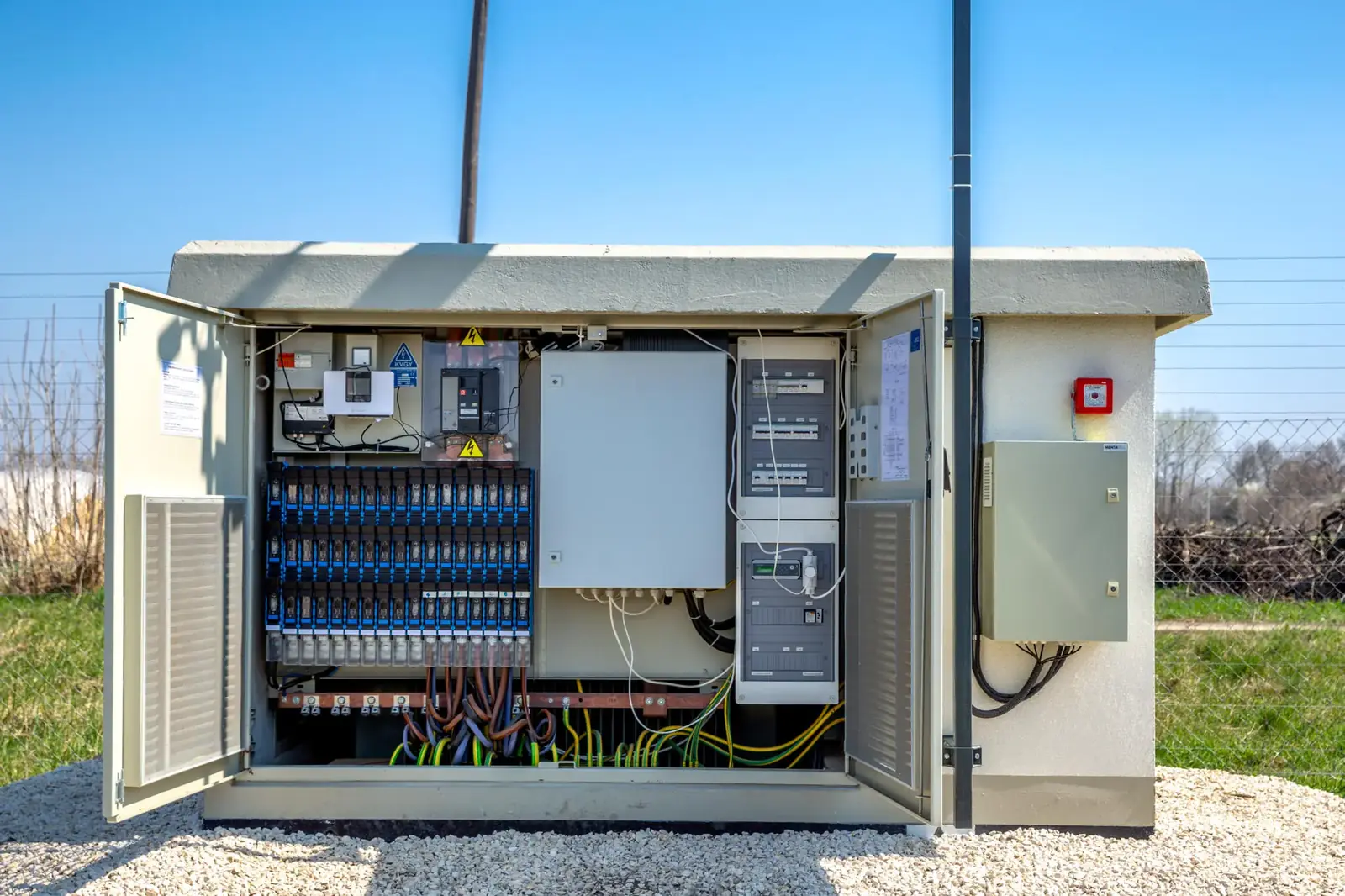
The part of a transformer substation or junction box from which low-voltage circuits are fed, usually protected by fuse switch-disconnectors.
LV — low voltage (nn)
Voltage up to 1 kV. In distribution networks this mainly means the 0.4 kV (400/230 V) network supplying homes, farms and small businesses.
M
Micro-installation (mikroinstalacja)
A renewable installation with installed capacity of no more than 50 kW, connected to a network below 110 kV. It is connected under simplified rules, usually on notification to the DSO.
MV overhead line
A medium-voltage line with conductors suspended on insulators from concrete, steel or wooden poles. Cheaper to build than a cable line but more exposed to weather.
MV switchgear
A set of bays with medium-voltage switching, protection and metering equipment. Substations and junction boxes use, among others, compact gas- or air-insulated switchgear.
MV — medium voltage (SN)
Voltage above 1 kV and below 110 kV. Polish distribution networks most commonly use 15 kV and 20 kV MV lines, less often 6, 10 or 30 kV.
MV/LV transformer
Equipment that steps voltage down from MV to 0.4 kV. Distribution networks are dominated by hermetically sealed oil-immersed transformers; dry-type units are used in some applications.
MV/LV transformer substation
An installation in which a transformer steps medium voltage down to 0.4 kV. It usually contains MV switchgear, a transformer and an LV switchboard protecting the outgoing circuits.
N
NA2XS(F)2Y
A single-core MV cable designated under the German system: N – standard cable, A – aluminium conductor, 2X – XLPE insulation, S – copper screen, (F) – longitudinally watertight screen area, 2Y – polyethylene sheath.
P
Packaged (kiosk) substation
A prefabricated MV/LV substation in a concrete or metal enclosure, delivered to site as a finished module. It may be operated from outside or have an internal operating corridor.
Pilot bore
The first, steered stage of an HDD crossing. A drill head fitted with a transmitter is guided along the designed path from the entry point to the exit point.
Pipe jacking / pipe ramming (przecisk)
A trenchless method of installing a pipe over a short distance, usually in a straight line between two pits, for example with a pneumatic piercing tool or hydraulic unit. Unlike HDD, the path cannot be steered during the work.
Pole-mounted substation
An MV/LV substation with the transformer mounted on a pole structure and fed from an overhead line. Used mainly in rural areas to supply smaller groups of customers.
Protective duct (rura osłonowa)
A pipe, usually PE or PVC, protecting a cable where it is exposed to mechanical damage: under roads, at crossings with other utilities, in drilled crossings and culverts.
R
Reamer
A tool pulled back through the pilot bore to enlarge it to a diameter that allows the protective ducts to be pulled in.
Renewable energy sources (OZE)
Energy sources using solar radiation, wind, water and biomass, among others. Solar and wind farms are most often connected to the MV or HV network.
Rime and ice loading (sadź)
Ice and rime accumulating on overhead line conductors in certain weather conditions. It increases the load on conductors and poles and can cause failures.
Road occupation permit
Permission from the road authority to carry out works or place equipment within the road corridor, usually subject to a fee and time-limited.
RS — MV switching station
Rozdzielnia sieciowa: an MV switching station without HV transformation, where several medium-voltage lines are connected and distributed. It allows the network to be sectionalised and fed from different directions.
S
SAIDI and SAIFI
Supply reliability indices: SAIDI is the average total interruption time per customer per year, SAIFI the average number of interruptions. They feed into the assessment of operators' performance.
Sand bedding and backfill
Layers of sand or suitable soil below and above the cable. They protect the sheath from sharp stones and improve heat dissipation from the cable.
Separable connector termination
A screened MV cable termination in the form of a plug pushed onto an equipment bushing, for example in a ZKSN junction box or substation switchgear. It provides a compact, touch-safe connection.
Service connection (przyłącze)
The section of network linking the connected party's equipment to the operator's network, for example an MV cable from an existing line to a solar farm's ZKSN junction box.
Solar (PV) farm
An installation made up of many photovoltaic modules, inverters and transformer substations that feeds energy into the power grid.
Surge arrester
A device protecting equipment insulation against lightning and switching overvoltages. Installed, among other places, on poles with cable terminations and in pole-mounted substations.
Switch-disconnector
A switching device capable of making and breaking normal load currents. Combined with fuses, it protects, for example, the transformer in an MV/LV substation.
T
Telecontrol (telemechanika)
A system for remote control and monitoring of network equipment, such as switch-disconnectors in ZKSN junction boxes or substations. It helps the operator locate faults and restore supply faster.
Traffic management plan
A document setting out signage and traffic arrangements for the duration of works in the road corridor. It must be approved by the competent traffic authority.
Transmission easement (służebność przesyłu)
A right over a property in favour of a utility company, allowing it to use the land as needed to build and operate its network.
TSO — transmission system operator (OSP)
The operator of the extra-high-voltage transmission grid. In Poland this role is performed by Polskie Sieci Elektroenergetyczne (PSE).
U
Undergrounding (skablowanie)
Replacing a section of overhead line with a cable line laid in the ground, usually followed by removal of the poles and conductors. Operators use it to reduce faults caused by weather and trees.
URE — Energy Regulatory Office
Poland's energy-sector regulator. Among other things it approves operators' tariffs, grants licences and monitors the quality of distribution services.
Utility conflict (kolizja)
A place where an existing utility network clashes with a planned development such as a road. It is resolved by relocating the network before the main works begin.
V
Voltage test
A test in which cable insulation or the sheath is subjected to an elevated test voltage for a specified time. It reveals installation defects or damage caused during laying.
W
Warning tape
A strip of plastic laid in the trench above the cable. It warns anyone carrying out later excavation that a cable lies below.
X
XLPE — cross-linked polyethylene
The insulating material used in modern MV and HV cables. It tolerates high conductor operating temperatures and has low dielectric losses.
XRUHAKXS
A single-core medium-voltage cable in the Polish designation system: aluminium conductor, cross-linked polyethylene (XLPE) insulation, copper wire screen, longitudinal water sealing and a polyethylene sheath. Widely used in 15 and 20 kV MV lines.
Y
YAKXS
Low-voltage power cable with aluminium conductors, PVC insulation and a polyethylene sheath. Common in LV cable networks laid in the ground.
YAKY
LV cable with aluminium conductors and PVC insulation and sheath. A classic cable type for low-voltage networks and service connections.
Z
ZK — LV cable junction box
Złącze kablowe: a low-voltage cabinet with protective devices where the DSO's network ends and the customer's installation begins, or from which further LV circuits are taken. Type codes such as ZK1x-1P describe its layout and number of bays.
ZKSN — MV cable junction box
Złącze kablowe średniego napięcia: a free-standing cabinet with MV switching equipment used to connect MV cable sections, take off branches or connect a customer or generator. It usually has several bays, for example two line bays and one branch bay.
ZUD / utility coordination meeting
Coordination of the location of planned utility networks, conducted by the district authority (in some cities by the city mayor) as a coordination meeting. It helps avoid conflicts with other networks; the exact procedure depends on current regulations and local practice.
See also
Terms in practice
MV cables: XRUHAKXS and NA2XS(F)2Y
MV cables XRUHAKXS and NA2XS(F)2Y explained: construction, how to read the designations, conductor and screen sizes, voltage ratings and use in 15–20 kV lines.
Learn moreHow directional drilling works
How horizontal directional drilling works: pilot bore, reaming, duct pullback and bentonite. When HDD is used, how it differs from pipe jacking, and its limits.
Learn moreFrom design to acceptance — building a line
Stages of building an MV cable line: design and approvals, site preparation, trenching and drilling, cable laying, accessories, testing and handover.
Learn moreLooking for an MV or LV network contractor?
Send us the design or a description of the scope — we will reply with a quote and a proposed schedule.