
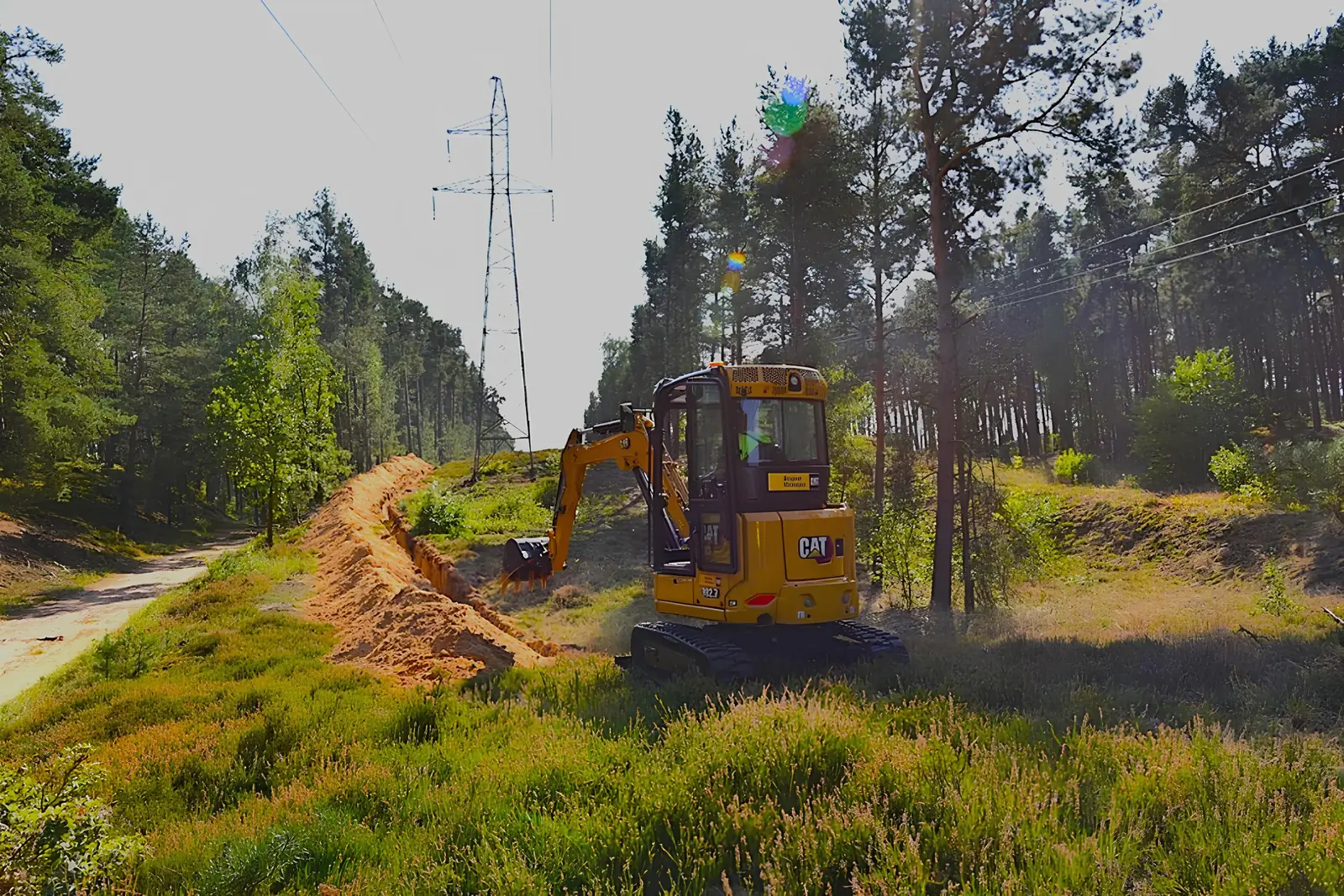
ENEA Operator · MV 20 kV / LV 0.4 kV
Construction and dismantling of the MV 20 kV and LV 0.4 kV power network in Niegosławice municipality
A contract awarded directly by a distribution system operator — ENEA Operator, Zielona Góra Distribution Branch — with BIGBUD as consortium leader. In just over seven months, three new MV/LV transformer substations and an MV cable line of 3 × 5,715 m were built, and 8.266 km of MV overhead line with 89 pole positions disappeared from the landscape. Value of the works: PLN 2,405,200 net.
| Client | ENEA Operator sp. z o.o. — Oddział Dystrybucji Zielona Góra |
|---|---|
| Location | Stara Jabłonna, Nowa Jabłonna, Zimna Brzeźnica (gm. Niegosławice) Lubuskie Voivodeship |
| Voltage | SN-20 kV / nn-0,4 kV |
| BIGBUD's role | Consortium leader (partner: TECHNO-BUD sp. z o.o.) |
| Net value | PLN 2,405,200 net |
| Completion period | 16 Oct 2025 – 28 May 2026 |
Reference letter
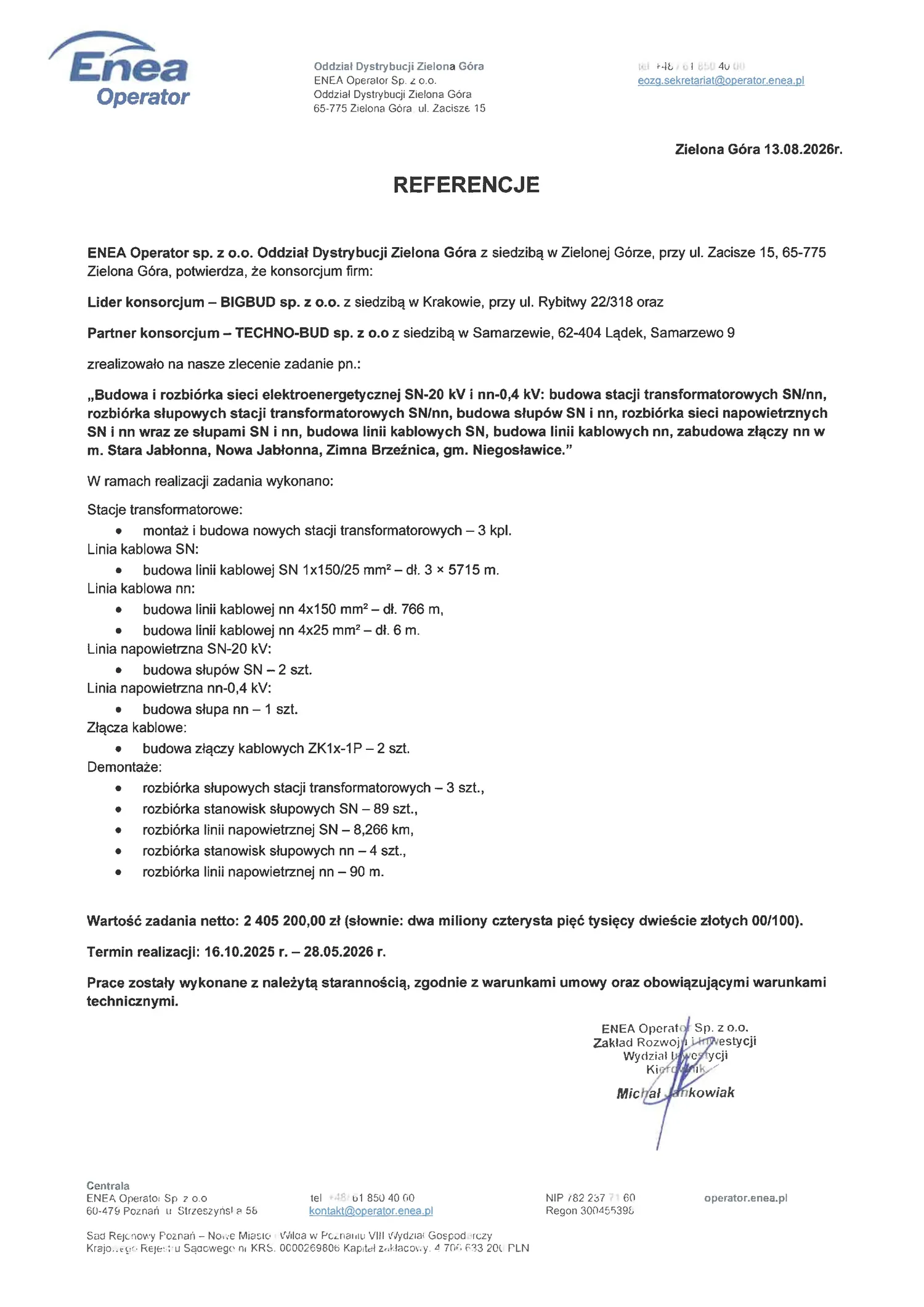
Signed by: Michał Jankowiak, Kierownik Wydziału Inwestycji
The task
A DSO contract, with BIGBUD leading the consortium
ENEA Operator is a distribution system operator (DSO) — the company that operates and develops the distribution network in its service area and is responsible for delivering electricity to connected customers. Working on a DSO investment means building to the operator's own technical, material and acceptance standards.
The Zielona Góra Distribution Branch commissioned the task named „Budowa i rozbiórka sieci elektroenergetycznej SN-20 kV i nn-0,4 kV…” — construction and dismantling of the MV 20 kV and LV 0.4 kV network: building MV/LV transformer substations, dismantling pole-mounted MV/LV substations, erecting MV and LV poles, dismantling MV and LV overhead lines together with their poles, building MV and LV cable lines and installing LV cable junctions in Stara Jabłonna, Nowa Jabłonna and Zimna Brzeźnica, Niegosławice municipality.
The contract was delivered by a consortium: leader — BIGBUD sp. z o.o., partner — TECHNO-BUD sp. z o.o. of Samarzewo. A consortium leader represents the contractors before the client and coordinates delivery of the whole contract, from scheduling and site organisation to invoicing and acceptance. This is our most important reference: it shows we can run a DSO contract as a party to the agreement, not only as a subcontractor.
- Client: ENEA Operator sp. z o.o., Zielona Góra Distribution Branch
- BIGBUD's role: consortium leader (partner: TECHNO-BUD sp. z o.o.)
- Period: 16 Oct 2025 – 28 May 2026 — the schedule ran through the winter months
How the works went
Replacing an overhead network with cable — step by step
Below is the typical sequence of such works, mapped to the scope confirmed in the reference letter. It is a network swap: the new infrastructure is built first, customers are then transferred, and only at the end is the old line taken down.
Preparation and site organisation
On a DSO contract, work starts with taking over the site, surveying the route, agreements with landowners and road authorities, and planning outages. In a consortium there is also the split of scope and a joint schedule — keeping it coherent is the leader's job.
Scope of works
- setting out the line route and substation locations
- works schedule and outage planning with the operator
- logistics for cables, substations and accessories
MV cable line, 3 × 5,715 m
The core of the contract was an MV cable line built from single-core 1×150/25 mm² cable — three phases laid along a 5,715 m route. Typically this means trenching, preparing the bedding, laying cable from drums, jointing the factory lengths, backfilling with warning tape and reinstating the ground.
Scope of works
- trenching and laying MV cable
- joints and terminations
- as-built geodetic survey
Result
- 3 × 5,715 m of 1×150/25 mm² MV cable
Substations and LV network
Three new MV/LV transformer substations replaced the pole-mounted ones. The low-voltage network was run out from them: a 766 m LV cable line in 4×150 mm² and a short 6 m section in 4×25 mm², plus two ZK1x-1P LV cable junctions for customers. The scope also included two MV poles and one LV pole — poles of this kind typically serve as transition points between the new cable network and the remaining overhead network.
Scope of works
- installation and construction of MV/LV substations — 3 sets
- LV cable lines 4×150 mm² (766 m) and 4×25 mm² (6 m)
- ZK1x-1P cable junctions — 2
- MV poles — 2, LV pole — 1
Switch-over, testing and acceptance
Before entering service, the new line and substations undergo acceptance tests and measurements; customers are then transferred to the new network within outage windows agreed with the operator. As-built documentation and the geodetic survey are compiled.
Scope of works
- acceptance tests and measurements
- switching coordinated with the operator's control room
- as-built documentation
Dismantling the old overhead network
The final stage is removing infrastructure that is no longer needed: three pole-mounted transformer substations, 8.266 km of MV overhead line with 89 pole positions, and 90 m of LV line with 4 pole positions. Recovered materials are sorted and handed over as the client requires, and the land is cleaned up.
Scope of works
- pole-mounted substations removed — 3
- MV line removed — 8.266 km, 89 pole positions
- LV line removed — 90 m, 4 pole positions
Result
- land cleared of the old MV overhead line
Technology
What sits behind the items in the letter
A short, general explanation of the elements in the contract scope.
Why DSOs underground MV lines
A cable line is immune to wind, ice and falling branches — common causes of faults on overhead networks in rural and wooded areas. DSOs therefore replace overhead sections with cable to cut the number and duration of supply interruptions. More in Why operators underground MV lines.
1×150/25 mm² MV cable in three phases
“3 × 5,715 m” means three single-core cables — one per phase — laid along a single 5,715 m route. The figures 150/25 give the cross-section of the conductor (150 mm²) and of the metallic screen (25 mm²). We cover MV cable types in MV cables: XRUHAKXS and NA2XS(F)2Y.
Removing 89 pole positions
A pole position is the pole together with its foundation, cross-arm, insulators and fittings. Dismantling involves taking down the conductors once the line is de-energised and earthed, stripping the fittings, extracting or demolishing poles and foundations, hauling the material away and restoring the land — often in fields and woodland.
A ground substation instead of a pole-mounted one
A transformer substation steps voltage down from 20 kV to the 0.4 kV that supplies customers. When the MV network goes underground, pole-mounted substations are replaced by cable-fed ones. See MV/LV substations and Inside an MV/LV substation.
„The works were performed with due diligence, in accordance with the terms of the contract and the applicable technical requirements.”
See also
Overhead line undergrounding
Undergrounding of MV and LV overhead lines: new cable line, HDD crossings, ZKSN junctions, switching and removal of the old line, poles included.
Learn moreMV/LV substations
Construction of MV/LV transformer substations, ZKSN and LV cable junctions, replacement of pole-mounted units, MV and LV cable connections and testing.
Learn moreFor distribution system operators
BIGBUD for distribution system operators: MV line construction and undergrounding, MV/LV substations, dismantling and acceptance documents. ENEA Operator reference.
Learn moreOther projects
Toruń — MV 15 kV line undergrounding
MV 15 kV line undergrounding in Toruń for ZILINSKIS: 5,725 m of 3× XRUHAKXS 1×150 mm², 2 ZKSN junctions, ~600 m of directional drilling. PLN 682,000 net.
Learn moreKonin — RS Maliniec 15 kV switching station
MV feeder cables for the RS Maliniec 15 kV switching station in Konin for ZILINSKIS: 5,410 m of 3×XRUHAKXS 1×240, ZKSN junction, ~350 m HDD. PLN 642,000 net.
Learn moreMV/LV network rebuild — 8 villages
MV/LV network rebuild in 8 villages for PIWOWARSKI: 5,606 m of 3×NA2XS(F)2Y 1×150/25 mm² cable, ~550 m of drilling and pipe jacking. PLN 486,120 net.
Learn morePreparing an undergrounding or network rebuild contract?
We can bid on our own, as consortium leader or as a partner. Send us the tender documents and we will come back with a price.