
Knowledge · Undergrounding
Why distribution operators are replacing MV overhead lines with cables
Undergrounding is one of the main directions of medium-voltage network modernisation in Poland. Here is why — and what it looks like in practice.
For decades, rural medium-voltage networks were built mainly as overhead lines: poles, insulators and bare conductors were cheap to build and easy to repair. Today distribution system operators are increasingly replacing such lines with cables laid in the ground. We explain what drives this, the pros and cons of each solution, and how undergrounding is carried out step by step.
What undergrounding a line means
Undergrounding (in Polish, skablowanie) means replacing a section of overhead line with a cable line laid in the ground. In practice it usually involves building a new cable line, often on a new route — along roads rather than across fields and forests — switching the supply over to the cable and then removing the conductors, insulators and poles of the old line.
Undergrounding rarely concerns the line alone. The points where the line branches or supplies customers are usually rebuilt at the same time: free-standing substations replace pole-mounted ones, MV cable junction boxes (ZKSN) replace pole-top branches, and part of the low-voltage network also goes underground.
Supply reliability and quality indices
The main reason for undergrounding is reliability. Operators' performance is measured by indices including SAIDI (average total interruption time per customer per year) and SAIFI (average number of interruptions). These indices are monitored by the Energy Regulatory Office (URE) and reflected in quality regulation, so operators have a strong incentive to improve them.
An overhead line is exposed to many events that a buried cable is practically immune to: branches blown onto conductors, falling trees, lightning strikes, conductors snapped by wind, contact with farm machinery or birds. Any such event can trip an entire feeder and interrupt supply to many customers. By replacing the most fault-prone sections with cable, the operator reduces the number of such events.
It also matters that in rural networks a single MV line often supplies a dozen or several dozen transformer substations spread over a wide area. A fault near the start of such a feeder affects every customer beyond it until it is located and isolated. Undergrounding the most exposed sections, combined with the ability to sectionalise the network at junction boxes, reduces both the number and the duration of interruptions.
Storms, icing and lightning
Increasingly frequent extreme weather is the second major argument. Strong winds break trees and poles, while wet snow and rime ice building up on conductors increase the load on conductors and structures and lead to breakages. After widespread storms, repairing an overhead network can take many days, because crews have to reach every damaged spot, often in difficult terrain.
A cable in the ground is largely isolated from these phenomena. That does not mean it never fails — it can be hit by an excavator during third-party works or fail at a poorly installed joint — but it is not vulnerable to wind, icing and falling trees.
Lines through forests and woodland
Lines running through forests are a special case. An overhead line needs a maintained clearance corridor, meaning trees and branches must regularly be cut back to a safe distance from the conductors. That is a cost for the operator, an intrusion into the woodland and a source of disputes with landowners. Even so, trees outside the corridor can still fall onto the line in a storm.
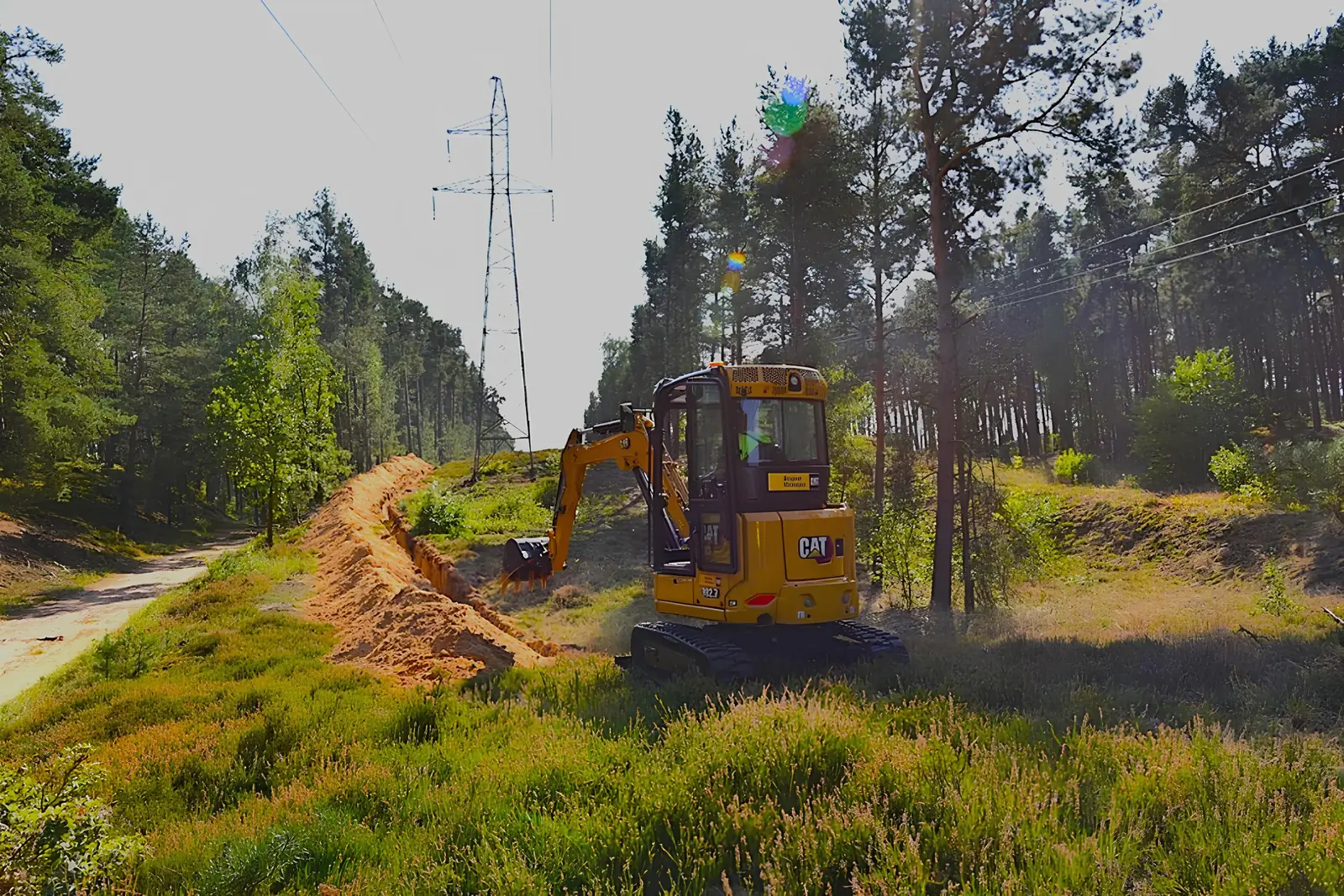
Once undergrounded, with the line running along a forest road for example, the clearance corridor is no longer needed and the risk of tree-related faults falls significantly. Where the cable has to pass under a road, a watercourse or near valuable trees, directional drilling is used to keep excavation to a minimum.
Safety, landscape and land use
A cable line improves safety: there is no longer a risk of contact with a broken conductor lying on the ground, a vehicle hitting a pole, or farm machinery or a crane coming too close to live conductors.
Landscape and land use matter too. Removing poles from fields makes farming and the movement of agricultural machinery easier, and in villages it improves the look of the streets. There is also less need to enter private land for maintenance — a line running along a road is more accessible to the operator's crews than an overhead line crossing fields. For municipalities and investors it means fewer constraints on the development of plots the line used to cross.
Drawbacks and limits of cable lines
Undergrounding is not without drawbacks. When deciding on it, the operator also weighs:
- Higher construction cost — a cable line usually costs more than an overhead line of the same length, especially when it requires many drilled crossings and surface reinstatement.
- Harder fault location and repair — a cable fault has to be pinpointed with specialist equipment, excavated and repaired with joints. This takes longer than replacing an insulator on a pole, although faults occur less often.
- Effect on network operation — a cable network has a much higher capacitance to earth than an overhead one, which increases capacitive currents during earth faults. With a high share of cable, the operator has to take this into account in neutral earthing and protection settings.
- Route approvals — a new route along roads requires consent from road authorities, coordination with other utilities and often traffic management plans.
A cable line also has to be built with great care. Defects in joint installation or sheath damage caused during laying may only show up years later. That is why operators attach great importance to accessory quality, jointers' qualifications and acceptance testing.
As a result, operators underground mainly the most fault-prone and exposed sections — wooded areas, forests, feeders with many customers — and take these decisions within their network development plans.
Undergrounding, substations and the LV network
An MV line rarely runs “point to point” with no customers along the way. In rural areas it usually supplies many small transformer substations, from which low-voltage circuits run to homes and farms. Undergrounding an MV line therefore involves decisions about these points.
Pole-mounted substations fed from the overhead line lose their supply once the line is removed. The operator then has several options: replace them with free-standing packaged substations fed by cable, keep a short stretch of overhead line with cable terminations on a termination pole, or rebuild the LV network so that one new substation replaces several old ones. The choice depends on where customers are, the load and the shape of the network.
Branches, which on an overhead line were made at poles with disconnectors, are usually made in MV cable junction boxes (ZKSN) on a cable network. A junction box with several bays supplies the branch and also allows the line to be sectionalised — switching off one section without cutting supply to the others. Junction boxes may be fitted with telecontrol, allowing the operator to switch supply remotely and isolate faulty sections faster.
The low-voltage network is often rebuilt together with the MV line, because LV poles are sometimes shared or stand in the same corridor. Such projects include building LV cable lines and ZK cable junction boxes supplying customers, and removing the old LV conductors and poles.
For more on how substations are built and equipped, see Inside an MV/LV substation.
How undergrounding works, step by step
Every project is a little different, but the typical sequence of works is similar:
- Design and approvals — the designer sets out the new route, the connection points to the remaining overhead network, the locations of junction boxes and substations, and the drilled crossings. The route is agreed with landowners, road authorities and other utility owners.
- Site preparation — setting-out survey, notifications, traffic management, delivery of cables and accessories.
- Building the cable line — trenching, directional drilling and pipe jacking under obstacles, laying cables in the ground and in protective ducts, installing ZKSN junction boxes and transformer substations.
- Installing accessories — joints connecting cable lengths, connector terminations in junction boxes and substations, outdoor terminations on poles where the cable meets the remaining overhead line.
- Testing and switching — after acceptance tests, the operator switches the supply to the new line.
- Removing the old line — taking down conductors, removing insulators, poles and pole-mounted substations, and tidying the land.
- As-built survey and acceptance — as-built survey, documentation and handover of the network for operation.
Each stage is described in detail in From design to acceptance — the stages of building an MV cable line.
Examples from our projects
Two of our projects show well what undergrounding looks like in practice.
Toruń — undergrounding of the 15 kV line GPZ Toruń Podgórz – Włocławek 3 with the Brzoza 1, Brzoza 2 and Brzoza 3 branches. As a subcontractor to ZILINSKIS, we built an MV cable line of 3×XRUHAKXS 1×150 mm² with a route length of 5,725 m, installed two ZKSN junction boxes (Brzoza 5 and Brzoza 6), carried out about 600 m of directional drilling and pipe jacking, and installed 6 sets of 15 kV MV cable joints and 4 sets of connector terminations. The works ran from 30 September to 25 November 2024.
ENEA Operator — rebuild of the 20 kV MV and 0.4 kV LV network in Niegosławice municipality (Stara Jabłonna, Nowa Jabłonna, Zimna Brzeźnica). As consortium leader, we built three new MV/LV transformer substations and an MV cable line of 1×150/25 mm² with a length of 3 × 5,715 m, together with LV cable lines and cable junction boxes. We then dismantled 8.266 km of MV overhead line with 89 pole positions, three pole-mounted transformer substations and sections of the LV overhead network. The schedule, from 16 October 2025 to 28 May 2026, ran through the winter months.
Both projects show the typical elements of undergrounding: a new cable line with drilled crossings under obstacles, junction boxes and substations replacing the former overhead equipment and — where it was in scope — removal of the old network and reinstatement of the land.
Find out more about how we deliver this work on our overhead line undergrounding page.
See also
Read next
Overhead line undergrounding
Undergrounding of MV and LV overhead lines: new cable line, HDD crossings, ZKSN junctions, switching and removal of the old line, poles included.
Learn moreENEA Operator — MV 20 kV network, Niegosławice
BIGBUD as consortium leader for ENEA Operator: 3 MV/LV substations, MV cable line 3 × 5,715 m, 8.266 km of MV overhead line removed. PLN 2.4m net.
Learn moreToruń — MV 15 kV line undergrounding
MV 15 kV line undergrounding in Toruń for ZILINSKIS: 5,725 m of 3× XRUHAKXS 1×150 mm², 2 ZKSN junctions, ~600 m of directional drilling. PLN 682,000 net.
Learn morePlanning to underground an MV line?
We build cable lines, junction boxes and substations and dismantle old overhead lines — as main contractor, consortium leader or subcontractor.